I think one of my first experiences with teaching is instructing sailing at an age of 14. At upper secondary school, I was a tutor for several years, helping fellow students with mathematics and physics. When I was 16, I became an instructor in a martial art (Pencak Silat). In hindsight, it thus seemed a logical step to do the minor education in my third year of the study Applied Physics and to become a secondary school teacher after my masters. I have been teaching physics in secondary school for ten years (2009-2019).
Recognizing that I probably had not yet reached my full potential and wishing to set an example for my pupils that learning is a lifelong journey, I applied for the NWO Doctoral Grant for Teachers. This grant was awarded in 2014, allowing me to do a PhD. (0.4 FTE - 5 years) on teaching scientific inquiry in physics Pols, 2023.
In 2019 I switched from secondary education to university to become the coordinator of the First Year Physics Lab Course (FYPLC) with the task to innovate this course.
Innovating lab courses
In 2019 I started my position at TU Delft as a lecturer/innovator (docent 2) of two lab courses: the First Year Physics Lab Course (FYPLC) and Introduction to Experiments in Physics, a course for the minor modern physics.
The first-year physics lab course (TN1405, 6 ECTS) was largely unchanged from its format in 2004 when I took the course as a first-year student. The course had run more or less the same for 40 years and was not much appreciated in the last two decades.
The course that was taught to third year minors (TN2985 - 2 ECTS) was an almost one-on-one translation of the first year course and was not much appreciated by the students.
The assignment given by Prof. Chris Kleijn (then program director) had three objectives:
Modernize the courses to align with 21-century educational standards.
Increase student motivation for the practicum.
Focus on teaching students how to conduct research.
After a year of getting acquainted with the two courses, identifying the bottlenecks and possibilities (also for the administration that was still done on paper and therefore labor intensive), I started the innovation process in 2020. The results of the innovation have been published in several educational journals and conference proceedings - especially in Pols & Dekkers (2024) .
To summarize, the main changes in the FYPLC that were implemented are:
Redesign of the entire course to focus on research skills and scientific thinking instead of following instructions to perform experiments.
Introduction of a new practicum on determining g with 0.1% accuracy.
Introduction of a final project where students design and conduct their own experiments (given some constraints).
Introduction of a final exam covering Python, data analysis, measurement and uncertainty.
Implementation of blended learning, reducing contact hours by 50% and allowing students to prepare at home.
Digitization and automation of administrative tasks, enabling TAs to manage attendance and grading independently.
Complete revision of the labcourse manual (twice), with links to lectures, assignments, interactive quizes and activities etc.
Revision of grading rubrics.
A new program was developed for the minor course. Students now enjoy significant flexibility, both in progressing at their own pace (for Python and report writing) and in choosing experiments. As a result, student satisfaction increased from 5.7 (2019) to 8.0 (2020) to 8.2 (2021) and 8.4 (2025).
Note that a 6-ECTS practicum with around 240 students cannot function without TAs. Major changes have been implemented here as well: Active recruitment has been established, based on performance, engagement, and interest during the academic year. Efforts have also been made to retain TAs longer, partly through specialized ITAV training and targeted professional development. But also by granting them greater responsibility and agency, and by creating a supportive and inclusive TA environment. The total number of TA hours was reduced by scaling up, conducting the same experiments in a studio classroom, and designating one day for centralized (online) instruction (resulting in a yearly cost reduction of ~30k€).
With the renewed physics curriculum of 2025, the FYPLC has been further adapted. Rather than one lab course, it now consist of two courses of 5 ECTS each, one in the first quarter and one in the second quarter. The first course was directly adopted from the previous FYPLC, no adjustments were needed. The second course, however, was redesigned to better align with the content of the second quarter (thermodynamics). Together with Roel Smit we designed nine laboratory activities and ten thermodynamic simulations aiming to develop better understanding of thermodynamic concepts at the macroscopic level through a focus on microscopic particle behavior, as seen in Figure 2.
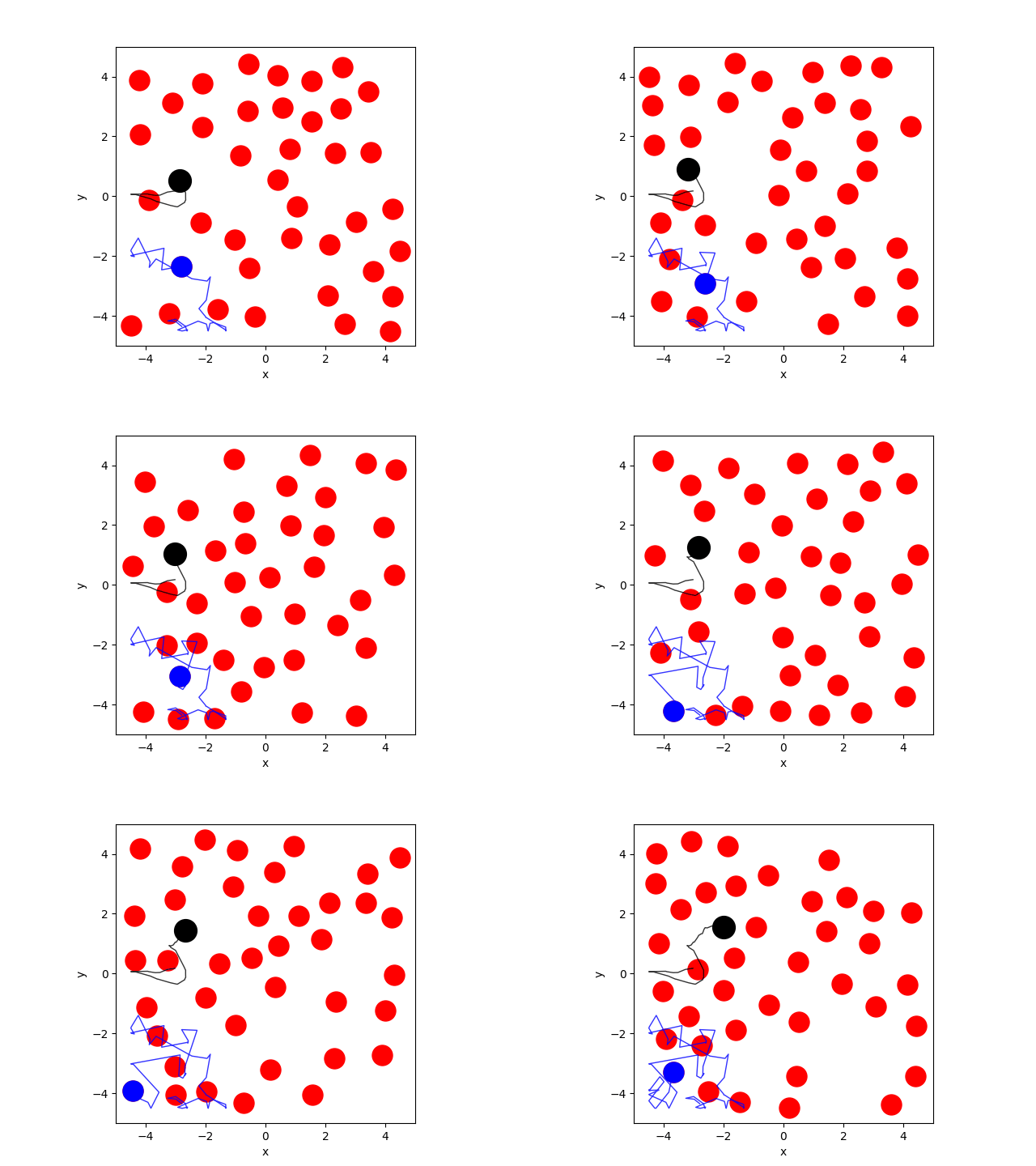
Figure 2:One of the simulations students have to develop where they compare Brownian motion of gas particles (red and blue) to a single heavier atom (black dot). The trajectories of a single light and the heavy particles are shown. Note that the full animation can be seen online only.
Teaching in the teacher education program
I have been involved in the teacher-education program at TU Delft already for a long time. It started with teaching specialized topics as labwork in science education and the use of ICT in physics education. Over the years my involvement has increased, contributing (e.g.) to the development of a new course (implementation of education) - where students ought to consider the merits and trade-offs of different educational approaches (like doing an educational escaperoom) and test it in their own class.
With the upcoming retirement of the main physics teacher educator, my involvement in the program has increased, e.g. in supervising master thesis projects. Related to this is my senior university teaching qualification (SUTQ) project. The SUTQ project focused on The development of a learning pathway on scientific inquiry in the teacher-education program. The teacher education program lacked a coherent sequence on educational research whilst students of the two year masters program were still expected to do a research project. Moreover, the various teachers involved seem to have different opinions about the role and nature of educational research in the program. In the SUTQ project (2025-2026) I addressed why, what, when, by whom, and how we are teaching educational research in TU Delft’s teacher-education program. This project has led to a blueprint for a learning pathway which is currently further developed and implemented.
Vision statement on education
Philosophy: My philosophy in and on education is that I want students to develop (in a structured way) a sense of what (scientific) quality entails. For teaching in the first year physics lab course, this means that I want students to learn how to make well-considered choices throughout the research process. There is no single method in science, and there are no set procedures that always lead to the best result. The question at the core is What decision leads to the best result in the given circumstances? Hence, rather than telling students what to do - or let them following a recipe - they should consider the quality of their choices and actions throughout the process and, ultimately, be able to argue why their decision is defensible in light of the constraints at that specific moment in time. [1]
In the teacher-education program I use a similar approach: there are so many ways to engage pupils in learning physics, I hardly can cover all of them. However, we might enable pre-service teachers to develop a sense of what quality teaching is, recognize it and therefore understand whether to adopt and adapt a certain teaching strategy or not.
This philosophy sets me as a teacher not in front of the class but in the middle of the classroom, coaching and guiding students in their learning process. I see my role as that of a facilitator who creates an environment (and materials) where students can explore, experiment, and learn from their experiences. This is not always successful as some students are more acquainted with the idea “tell me what to do, and I will do that (for you)”. However, in the end they all seem to benefit from my approach.
Technology: I like exploring new ways of teaching, especially with the use of technology. I explored and implemented the use of interactive textbooks (see impact section), and the use of ChatGPT. The latter might especially help students in writing - where I see a lot of potential but also want to be cautious that the AI is not taking over their thinking (and thus their learning process). Again, I want students to be able to develop a sense of what quality is, recognize it and therefore understand whether to adopt and adapt a text produced by genAI. Moreover, I have some caution as there is so much fun in finding things out.
Future: I aspire to continue my role in both the educational program of Applied Physics and the teacher-education program. I enjoy teaching physics, in particular teaching scientific inquiry. At the same time, I am increasingly aware of the societal urgency of the teacher shortage. I believe that universities have an important responsibility in addressing this challenge. Universities should not only be educating future engineers and scientists, but also actively stimulating and supporting students who may consider a career in education. Besides, I really like inspiring future teachers and enjoy their creative ways of engaging pupils in physics.
In a dual role as physics educator in the Applied Physics program and physics teacher educator in the teacher-education program, I believe I can contribute optimally to both programs. Through my involvement in the bachelor program, I reach approximately 200 students per year at an early stage in their academic development. This allows me to make a larger number of students aware that the teacher-education program exists and to inspire them to at least consider a career in education.
Moreover, I see strong potential for cross-pollination between the two programs. My involvement in teacher education allows me to bring current insights from physics didactics into the Applied Physics curriculum. Conversely, developments in university-level physics education (such as innovations in laboratory work, inquiry-based learning, and the use of open and digital tools) can enrich the teacher-education program. In this way, the dual role strengthens both programs and contributes to a more coherent and future-oriented educational ecosystem within the university.
Reflection
I believe that the above demonstrates that I am not only able to teach physics at different educational levels but also that I possess the skills and experience to innovate educational programs in a sustained and systematic manner, both at the level of individual courses and at the level of the curriculum. Furthermore, my work extends beyond teaching and local educational practice. I actively contribute to the development of education by disseminating insights, materials, and results through professional and academic journals, as well as through national and international conferences (see Appendix A). In doing so, I connect educational practice with scholarly reflection and contribute to the broader community of physics and physics education educators. Taken together, these activities reflect my readiness to take on greater responsibility and leadership in education, in line with the role and expectations of an associate professor with an emphasis on education.
I will come back to this in my research section.
- Pols, C. (2023). Development of a teaching-learning sequence for scientific inquiry through argumentation in secondary physics education [Phdthesis]. Delft University of Technology.
- Pols, C. F. J., & Dekkers, P. J. J. M. (2024). Redesigning a first year physics lab course on the basis of the procedural and conceptual knowledge in science model. Physical Review Physics Education Research, 20(1). 10.1103/physrevphyseducres.20.010117