Worked Examples
Slowing a mass down
We continue with the worked example from chapter 2: a mass, , has initial velocity . From onwards a force (with magnitude , ) is acting on , slowing it down. Eventually, will come to a stand still. The problem is 1-dimensional.
How much work has done?
First we make a sketch and draw what is relevant for this problem. We can use the same figure as used in chapter 2.
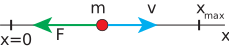
We conclude our interpret-phase with our idea on how to approach this problem:
the force is a friction force, hence it is not conservative.
work and change of kinetic energy are related:
we do know the velocity of at the beginning and at the end: and 0, respectively.
We can use the relation between work and kinetic energy:
We know the right hand side: and
Alternatively, we could also compute the work directly from its definition. In a 1-dimensional case that is:
Note: has sign; it is not the magnitude of .
From the relation between work and kinetic energy we get that the work done is:
The alternative approach using can be solved by realizing: points in the negative -direction, i.e. . It is a constant along the path from 1 to 2, hence integration is simple.
We have now two answers and, obviously, the should be the same.
From the first approach we learn: . That makes sense as the particle looses kinetic energy: it is slowed down by .
The same conclusion is drawn from the second approach. After all, .
To convince ourselves that we the two answers are the same, we need to go back to the solution of the problem in chapter 2. There we found that .
If we substitute this in our answer using the direct integration of over the path, we get:
As expected: we get the same answer.
Is friction a conservative force?
As a second example: let us investigate of the friction force, , of the above example a conservative force is or not.
Again, we start with a sketch and draw what is relevant for this problem. We can use a similar figure as above, but with even less detail.
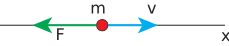
As we deal with a 1-dimensional problem, vector arrows above , or are not needed. But don’t be deceived: when dealing with work we have to evaluate an inner product and even in a 1-dimensional case quantities like force have direction.
We can proceed via different directions:
find a potential or show that this doesn’t exist;
show that always or find at least one closed path for which the work is non-zero.
We opt for the second approach: find one path from to for which .
Before finding such a path, let’s for a moment think about a potential . It seems almost too simple:
where we have chosen: .
So: do we conclude is conservative? After all, we seem to have found a potential! And if we use this, we quickly find the point where comes to a stand still:
which is the correct answer.
However: our answer is right, our reasoning is wrong.
How to understand this? Let’s go back to the closed path. If is conservative: the work done on when it goes from to most be the exact opposite from te work done when moves from to . So, let us compute this.
It is exactly equal! Of course, this is due to the nature of the friction force: it flips sign if moves in the other direction.
We conclude: and our force is not conservative; does not exist!
Where did the calculation of go wrong?
The integration seems quite ok, and it is. The problem is that we are sloppy with hoe we write . We use if moves in the positive -direction and if moves in the negative -direction. Actually: depends on the sign of the velocity . We should have written something like: with if , if and if .
Our lesson: if sloppy notation then errors are around the corner.
Cycling in a force field
The professor likes to cycle in a force field during his break. The force field is given by: . As he has to return for his next lecture, he cycles in a closed loop. He moves from (0,0) to (1,0) to (1,1) to (0,1) to (0,0) - or the other way around. Given that he has to have enough energy to educate the students, he wonders: how much work do I do during the ride and does that differ when I go clockwise?
Let’s first make a sketch of the situation. In this case we need to get some idea of the force field and the path. We can do that by plotting some vectors. This can be done by hand, but also by using Python:
Source
import numpy as np
import matplotlib.pyplot as plt


def plot_vector_field(F, xlim=(-.5, 1.5), ylim=(-.5, 1.5), N=20, scale=None):
    x = np.linspace(xlim[0], xlim[1], N)
    y = np.linspace(ylim[0], ylim[1], N)
    X, Y = np.meshgrid(x, y)

    Fx, Fy = F(X, Y)

    plt.figure(figsize=(5, 5))
    plt.quiver(X, Y, Fx, Fy, scale=scale)

    plt.arrow(1, 0, 0, .9, head_width=0.1, head_length=0.1, fc='red', ec='red', linewidth=2)
    plt.arrow(0, 1, 0, -.9, head_width=0.1, head_length=0.1, fc='red', ec='red', linewidth=2)
    plt.arrow(0, 0, .9, 0, head_width=0.1, head_length=0.1, fc='red', ec='red', linewidth=2)
    plt.arrow(1, 1, -.9, 0, head_width=0.1, head_length=0.1, fc='red', ec='red', linewidth=2)

    plt.xlabel("x")
    plt.ylabel("y")
    plt.xlim(xlim)
    plt.ylim(ylim)
    # plt.savefig("../images/ch3_ex_force_field.svg")
    plt.show()

def F(x, y):
    return y, 0

plot_vector_field(F)

def F(x, y):
    return y, 0

plot_vector_field(F)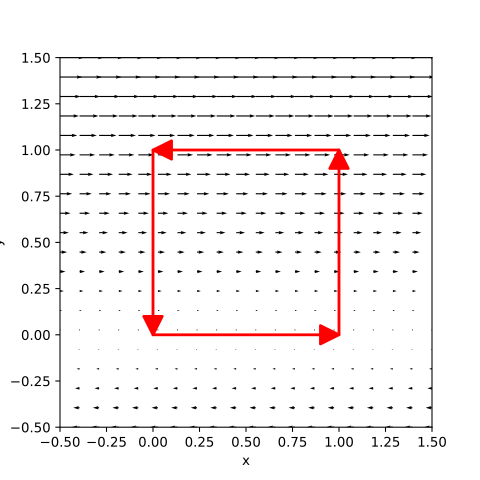
The force field that the professor is cycling in.
Looking at the force field and the path, we can see clearly that the path matters: from (1,1) to (0,1) the force is pointing in the opposite direction of the movement. At all other instances we can see that the force is either zero, or orthogonal to the movement.
Hence, to find the work done we only need to consider the segment from (1,1) to (0,1) and find
The only segment that contributes to the work done is from (1,1) to (0,1). Along this segment we have as exerted by the force field, hence exerted by the professor, and , or:
Although this is a simple case where drawing both the force field and the path helps a lot, we could have checked mathematically whether the force field is conservative or not. As described in conservative forces, a force field is conservative if the curl of the force field () is zero,see Appendix. In our case this means:
Hence, the force field is not conservative and the work done depends on the path taken. This is in line with our earlier conclusion.
Exercise set 1
Source
import numpy as np
import matplotlib.pyplot as plt
import ipywidgets as widgets
from ipywidgets import interact

# --- Parameters ---
x0 = 0.0
t_stop = 2.0
dt = 0.02
t = np.arange(0, t_stop + dt, dt)

def run_animation(v0, F, m):
    # --- Derived motion ---
    x = x0 + v0 * t + 0.5 * F / m * t**2
    v = v0 + F / m * t
    E_kin = 0.5 * m * v**2
    W = F * (x - x0)

    # --- Plot setup ---
    plt.clf()

    fig, axs = plt.subplots(2, 1, figsize=(15, 10))

    ax_position = axs[0]
    ax_ekin = axs[1]

    ax_position.plot(t,x,'k-')
    ax_position.set_xlim(0, t_stop)
    ax_position.set_ylim(min(x)-1, max(x)+1)
    ax_position.set_title("Position vs Time")
    ax_position.set_ylabel('$x$(m)')

    ax_ekin.plot(t,E_kin,'k-',label='$E_{kin}$')
    ax_ekin.plot(t,W,'r-',label='$W$')
    ax_ekin.set_xlim(0, t_stop)
    ax_ekin.set_ylim(0, max(E_kin)*1.1)
    ax_ekin.set_title("Kinetic Energy vs Time")
    ax_ekin.set_ylabel('$E$(J)')


# --- Interact control panel ---
interact(run_animation,
         v0=widgets.FloatSlider(min=0, max=10, step=0.5, value=5.0, description="v₀ (m/s)"),
         F=widgets.FloatSlider(min=-5, max=5, step=0.5, value=6.5, description="F (N)"),
         m=widgets.FloatSlider(min=0.5, max=5.0, step=0.1, value=1.0, description="m (kg)"))
Answers set 1
Solution to Exercise 1
a. Show
? How to compute it? For Cartesian coordinates there is an easy to remember rule:
If we chose our coordinates such that we get:
Thus is conservative.
b. Find a that satisfies
Does have a solution for V? Let’s try, using the same coordinates as above.
f,g,h are unknown functions. But all we need to do, is find one that satisfies .
So, if we take we have shown, that gravity in this form is conservative and that we can take for its corresponding potential energy.
By the way: from the first part (curl F = 0), we know that the force is conservative and we know that we could try to find V from
Solution to Exercise 3
Click for the solution Friction Not Conservative.
Solution to Exercise 4
Click for the solution Conservative Force.
Solution to Exercise 5
Click for the solution Non-Conservative Force.
Solution to Exercise 6
Click for the solution Potential energy & Force.
Solution to Exercise 7
Click for the solution Force Field.
Solution to Exercise 8
Click for the solution Sinusoidal Force Field.
Exercise set 2
Source
import numpy as np
import matplotlib.pyplot as plt
from matplotlib.animation import FuncAnimation
from IPython.display import HTML

#  Inputs
x0 = float(input('Initial position (m) from 0 to 10'))        # Initial position (m)
v0 = float(input('Initial velocity (m/s) from -10 to 10'))        # Initial velocity (m/s)
k = float(input('Spring constant (N/m) from 0.1 to 1'))       # Spring constant (N/m)
m = 2.0        # Mass (kg)

#  Derived
omega = np.sqrt(k / m)
t_stop = 4.0
dt = 0.02
t_values = np.arange(0, t_stop, dt)

#  Analytical solution for x(t)
C1 = 0.5 * x0 + 0.5 * v0 / omega
C2 = 0.5 * x0 - 0.5 * v0 / omega
x = C1 * np.exp(omega * t_values) + C2 * np.exp(-omega * t_values)

# Velocity is not needed directly as E_kin = total energy - work (from energy conservation)
W = 0.5 * k * (x**2 - x0**2)
v_squared = v0**2 + 2 * W / m
E_kin = 0.5 * m * v_squared

#  Plot setup
fig, axs = plt.subplots(2, 2, figsize=(10, 10))
ax_block = axs[0, 0]
ax_pos = axs[1, 0]
ax_ekin = axs[0, 1]
ax_work = axs[1, 1]

# Set axis limits
ax_block.set_xlim(min(x)-1, max(x)+1)
ax_block.set_ylim(-1, 1)
ax_block.set_title("Block motion")
ax_block.set_yticks([])
ax_block.axhline(y=-0.06, color='black', linewidth=5)

ax_pos.set_xlim(0, t_stop)
ax_pos.set_ylim(min(x)-1, max(x)+1)
ax_pos.set_title("Position vs Time")

ax_ekin.set_xlim(0, t_stop)
ax_ekin.set_ylim(0, max(E_kin)*1.1)
ax_ekin.set_title("Kinetic Energy vs Time")

ax_work.set_xlim(0, t_stop)
ax_work.set_ylim(min(W)*1.1, max(W)*1.1)
ax_work.set_title("Work vs Time")

# Artists
block_dot, = ax_block.plot([], [], 'rs', markersize=10)
line_pos, = ax_pos.plot([], [], 'b')
line_ekin, = ax_ekin.plot([], [], 'g')
line_work, = ax_work.plot([], [], 'r')

#  Init
def init():
    block_dot.set_data([], [])
    line_pos.set_data([], [])
    line_ekin.set_data([], [])
    line_work.set_data([], [])
    return block_dot, line_pos, line_ekin, line_work

#  Update function
def update(frame):
    t = t_values[:frame]
    block_dot.set_data([x[frame]], [0])
    line_pos.set_data(t, x[:frame])
    line_ekin.set_data(t, E_kin[:frame])
    line_work.set_data(t, W[:frame])
    return block_dot, line_pos, line_ekin, line_work

#  Animation
ani = FuncAnimation(fig, update, frames=len(t_values),
                    init_func=init, interval=dt*1000, blit=True)

plt.close(fig)  # Prevent double static plot
HTML(ani.to_jshtml())
Answers set 2
Solution to Exercise 9
The spring has mass as well.
The gravitational does work as well ()
Solution to Exercise 13
Solution to Exercise 15
Work done by electric field when the electron moves from to :
Work done is gain in kinetic energy: . Assuming the only work done is by the electric field and using initial velocity is zero: :
Note that indeed the work done is positive, as it should in this case since the electron starts with zero velocity.
Solution to Exercise 16
Particle velocity is Thus, trajectory since at Consequently:
Thus, we can write for the amount of work done:
We note: and naively, we could expect that the kinetic energy of the particle would have increased. But that isn’t the case: it started with and it kept this along the entire path as it is given that the particle is traveling with a constant velocity.
From this last statement, we immediately learn, that there must be a second force acting on the particle. This force is exactly equal and opposite to at all times! Otherwise, the particle would accelerate and change its velocity. Consequently, this second force also perform work on , the amount is exactly and thus the total work done on the particle is zero which reflects that the particle does not change its kinetic energy.
Exercise from Idema, T. (2023). Introduction to particle and continuum mechanics. Idema (2023)
- Idema, T. (2023). Introduction to particle and continuum mechanics. TU Delft OPEN Publishing. 10.59490/tb.81