Here are some examples and exercises that deal with oscillations.
Worked examples
Particle on a spring
A particle of mass is fixed to a spring (with spring constant and rest length ). The spring rests on a horizontal table, see figure. At , the spring has its rest length. The particle is released with zero velocity. What is the motion of the particle?
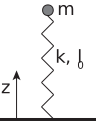
First we finish the sketch by drawing what is relevant for this problem.
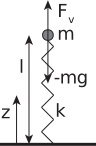
The motion of the particle is governed by gravity and the force exerted by the spring. Both act along the -axis, making this a 1-dimensional problem. We have a particle that is initially at rest and will start moving when it is released.
We will set up N2 and specify the initial conditions.
Note that the force from the spring has a negative sign! This needed to get the direction of the force right: if the length of the spring is stretched beyond its rest length, the particle is pulled down.
We have two initial conditions:
We can write N2 in terms of the position of the particle:
This is a second order differential equation. We can solve it by first finding the homogeneous solution and then a particular solution.
The homogeneous equation is:
with solution:
where .
Next we need a particular or special solution. We can find is by trying to find the steady state (or equilibrium) position. Thus we set .
Thus the general solution is
Now we apply the initial conditions:
And we find as solution
with
We see, that the particle will start oscillating as we expected. Moreover, the particle will first start moving downwards. This makes sense, as at gravity pulls down the mass, but the spring does not exert an upward force as it is at its rest length.
The particle start oscillating around . This makes sense: if we would have placed the particle at without initial velocity, it would stay there as the two forces acting on it would then exactly cancel each other.
Exercises
Answers
Solution to Exercise 1
a. equilibrium:
with the particle volume and the density of the particle.
b. N2: now we have to take the frictional force by the oil into account:
c. Rewrite this as
This equation describes a damped harmonic oscillator. It will oscillate sinusoidal with angular frequency
The general solution is:
Solution to Exercise 2
a.
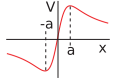
b. To find the equilibrium positions, we need to find the points where the derivative of the potential energy is zero:
The stability follows from inspecting
The same conclusion can also be drawn by inspecting the graph of .
c. Make a Taylor expansion around :
with and . Thus, we can write the energy for a small interval around as:
This is the energy of a harmonic oscillator with angular frequency and period .
Solution to Exercise 3
a.
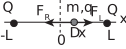
2 forces, both Coulomb type:
left charge , right charge
position:
left charge:
right charge:
equilibrium:
b. Energy conservation!! Coulomb force → potential exists: same relation with distance as gravity
So, energy conservation:
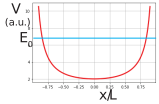
From a plot of the potential energy we see: the motion of is confined! Moreover, will oscillate, but probably not in a harmonic way!
c. Equation of motion:
d. Rewrite N2 using :
e. Make a Taylor series for the forces around :
Thus, for $ we find in good approximation:
harmonic oscillator!!
f. with frequency
Solution to Exercise 4
a. Kirchhoff:
b. relation charge and current:
Thus, we can write for the charge:
Damped harmonic oscillator!
‘mass’: , thus the coil is the mass=inertia
spring constant: , hence the capacitor is the spring, that generates the restoring force
friction: , the resistor is the damping.
acts as ‘position coordinate’
c. with driving voltage source:
This describes a forced, damped harmonic oscillator with general solution:
d. with
which has a maximum if the denominator is minimal, i.e. and
Thus, for Ohm, H and F: = 994 rad/s