Worked examples
Circular motion
Consider a particle of mass that is attached to a massless rope of length R. The other end of the rope is fixed in the origin and is free to rotate in a horizontal plane. The particle is made to move in a circular motion wit a velocity that has a constant magnitude . Show that on a force should act that is parallel to the rope at all times. Gravity is to be ignored.
Let’s start with a drawing: is moving over a circle in a horizontal plane. We draw its position vector, , its velocity vector, and a force, that can act on .
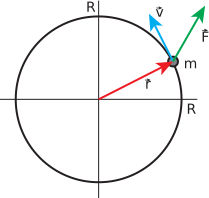
This is clearly a 2-dimensional problem: both and do change in the plane while moves along the circle. Moreover, since is not a constant vector (it does have constant magnitude , but clearly its direction constantly changes), we can anticipate that a force must be acting on . After all, is not a constant and, thus, according to N2 a force must act on .
We have at least two options to approach this problem: via momentum or via angular momentum. We opt for the latter, as we anticipate that the angular momentum may be a constant.
We are going to use angular momentum: . In this case and are always perpendicular ( moves over a circle and, hence is tangent to the circle at all times). Thus we can write:
with a unit vector perpendicular to the plane of motion. Next we may use Newton 2 for angular momentum:
and from this law find restrictions on .
Thus, we have for this case: : a constant vector as are all constant. Consequently, from N2 for angular momentum we get:
And we see that must be parallel to .
Our conclusion does make sense: the velocity of is constant in magnitude, thus no force can act parallel to since that would ‘speed up’ . But a force is required to keep in its circular orbit. After all, its velocity is changing with time and that requires a force acting on .
Unstable See-Saw
We have a seesaw as shown in the figure below. On the left side a mass is place, on the right side, . Both arms of the seesaw have a length and zero mass. For now, we keep the seesaw horizontal. But at , we let go.
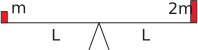
Is the seesaw stable for ?
If not: what is the initial acceleration of the mass (that is, its acceleration just after release)?
As always, we start with a drawing. That is, in this case we complement the figure given with relevant information for our interpret-phase.
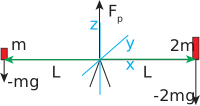
We have drawn: the two relevant forces of gravity acting om and , respectively, as well as the force of the pivot acting on the seesaw. Moreover, we have (in blue) indicated our coordinate system. This is useful, as we anticipate that we will have to deal with torques and angular momentum. Furthermore, we have drawn the position vector (in green) of both masses with the pivot point as our origin.
The figure is made with the idea that the stability of the seesaw for can be inspected by looking at the torques acting on it.
The seesaw is in balance if the sum of torques on it is zero. Thus, we calculate the net torque (using that the seesaw itself has no mass). We have chosen the pivot point as our origin, thus
If this is zero, then the seesaw will not start rotating.
If it is non-zero, the seesaw will start rotating and we analyze this by using
Stable or not?
The net torques is clearly non-zero: the seesaw is unstable (for ). It will start to rotate clockwise and we can find its initial acceleration as follows.
If we denote the velocity of as then will have as velocity. This is of course a consequence of both sitting om the seesaw with equal distance to the pivot point. Furthermore, both velocities are always perpendicular to the position vector of their mass. Again this is a consequence of sitting on the seesaw, that can only rotate around the pivot point. Thus the angular momentum of the seesaw (with the two masses) is:
This is not a constant, as is a function of time. From N2 for angular momentum
we learn that for small (i.e. gravity is still at 90° with the position vectors of and )
Thus, the initial acceleration is a third of .
Obviously, this seesaw is unstable. We knew that from experience. Our intuition is now backed up by a formal physics reasoning. Furthermore, we see that the initial acceleration is positive. Hence, the lighter mass starts moving upwards, also in line with our intuition.
Finally, we have computed the initial acceleration and, indeed, our answer has the right units: .
Exercises
Answers
Solution to Exercise 2
We first complete the drawing. As we need to think about the angular momentum, we need the position vector of . Furthermore, we need to include all forces acting on in order to evaluate the effect of all torques on .
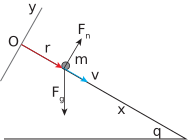
Apart from gravity also a normal force from the slope on is present.
Note: in the figure we have now for the position vector, the velocity and both forces set the size of to zero. As a consequence, and are parallel during the entire motion
Next step, we develop our solution strategy. As this exercise is concerned with angular moment, we will use N2 for angular momentum as well as, of course, the definition of angular momentum .
Now we evaluate our ideas:
since, in this case .
N2 for angular momentum reads as:
We know that the left hand side is zero: is constant. Thus, the sum of all torques on must also be zero. We have identified two forces acting on : gravity and the normal force. The latter does nothing but opposing the component of gravity perpendicular tot he slope (that is its -component). We split gravity in its and -component:
with this we compute the total torque on
The first term is zero because and the second one due to cancelling of the two forces in the brackets.
If we assess our answer, we see that this is perfectly in line with N2 for angular momentum: no net torque, hence no change of the angular momentum!
Solution to Exercise 3
We will exploit that the angular momentum of the earth and the comet are constant. The angular momentum is defined as . At the perihelion and at the aphelion, the position vector and the velocity are perpendicular. Thus, the angular momentum simplifies to , with the -coordinate of the perihelion or aphelion.
We can find these coordinates by realizing that at the perihelion and the aphelion, the -coordinate is zero. Thus,
where we have labelled the -coordinate of the perihelion as and of the aphelion as .
The velocity ratio of over is now easily found, by using that the angular momentum is a constant:
Putting in the given numbers, we find:
Does this make sense? Yes: the earth orbits in an ellipse that is close to a circle. Hence we expect only a mild difference between the velocity at the perihelion and the aphelion. For Halley’s comet this is rather different. According to Kepler’s law of equal area, the comets sweeps through the same area close to the sun (i.e. around the perihelion) and far away from the sun (the aphelion). As the distance to the sun close to the perihelion is much smaller than that around the aphelion, the velocity much be much smaller around the aphelion to ensure equal areas in equal times. Note: our expressions are dimensionally correct.
Solution to Exercise 4
The energy of the object is given by:
We can find the potential from the force:
where we have used that the force is central. Furthermore, we have taken as our reference point: infinity.
If the object follows a parabola, then its energy must be exactly zero. Thus:
a) This holds at any point of the trajectory. Thus for the point of closest distance to the force center we get:
b) Now that we have both the velocity and the position at one point on the parabola, we can compute the angular momentum. Since the force is central, we do know that the angular momentum is a constant. Hence, computing it for one particular point will give us the angular momentum for all points on the trajectory.
We use that at the point of closest approach the position vector and the velocity are perpendicular: . Thus the angular momentum is:
Note: the minus sign is needed to have the angular momentum point into the drawing as points towards us.
Solution to Exercise 5
According to Kepler 3, the orbital period, , and the length of the semi major axis, are related as:
with k a know constant, the same for all planets orbiting the sun. From this law, we immediately get that
Thus, if we want to find the relative distance to the sun of each planet (that is, we express in terms of which is 1 A.U.), we get:
Data
| planet | orbital period (year) | semi-major axis (A.U.) |
|---|---|---|
| Mercury | 0.241 | 0.39 |
| Venus | 0.615 | 0.72 |
| Earth | 1.000 | 1.00 |
| Mars | 1.881 | 1.52 |
| Jupiter | 11.86 | 5.20 |
| Saturn | 29.46 | 9.58 |
| Uranus | 84.0 | 19.2 |
| Neptune | 164.8 | 30.1 |
Fun fact: Neptune’s orbital period is so large, that since its discovery in 1846, it has only completed 1 Neptune-year (first full orbit in 2011!).
Solution to Exercise 6
First we make a sketch.
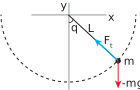
We have drawn gravity and the tension in the rod connecting the mass m tot the pivot point. From a physics point of view, the situation is as follows: the swing initially has only potential energy and it will gain kinetic energy on its way down, until all potential energy is converted into kinetic energy.
Two forces are acting on the swing, giving rise to two torques that cause the angular momentum to change. The velocity of the mass is always perpendicular to its position vector (a consequence of using a ‘clever’ choice for the origin of our coordinate system).
Now, we can set up the modeling for this problem.
Conservation of energy:
Angular momentum:
Change of angular momentum:
With this, we are ready for the develop phase. Conservation of energy gives us for the velocity at the lowest point:
The minimum angular momentum is of course at the highest point where the swing has zero velocity and changes direction.
Tha maximum angular momentum is at the lowest point:
Finally, the torque comes from gravity: . The tension in the rod is always parallel to the position vector of and thus has zero torque.
Solution to Exercise 7
a) The seesaw is balanced if: . Hence, we compute the net torque:
Thus the net torque is not zero and, indeed, the seesaw is unbalanced.
b) Where to place on the right hand side an additional mass ? We need to compensate by adding at some . Thus, we require:
and we find that we need to place at .
c) In the second situation, we need to rethink how to compute the total torque. It still requires to calculate the contribution of all small masses . We will label each small mass with index . It has a distance to the origin of . (Actually it does not have a single distance, but a varying one between and . But since is very small (and the same for all masses ), it is accurate enough to use . In your calculus classes you will get the proof of this.)
Next, we realize that each mass is given by
Thus, the net torque can be written as
This is a Riemann sum and if we let , we arrive at an integral:
In the final step, we will replace in terms of the mass of the bar. We do that by noting that the total mass of the bar is the sum of all small parts :
This is to be expected: the total length of the bar is and with a constant density per unit length we get the above result.
Thus in terms of we find:
If we substitute this in the equation for the net torque, we find:
Indeed, the seesaw is unbalanced.
Note: we have an expression for the torque with the right dimensions!
d) Now we can find the position where we should place a mass to balance the seesaw: we need to do that such that the net torque is zero.
Conclusion: by splitting up the real bar in infinitesimally small parts, we can still compute the net torque (with many thanks to Bernhard Riemann, 1826-1866, a German mathematician).
Solution to Exercise 8
First, we complete the sketch by adding the force.
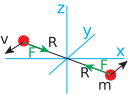
We note that the masses move under the influence of a central force. Hence, no torque is exerted and we conclude from N2 for angular momentum that the angular momentum is constant.
From this, we can find the momentum and, hence, the velocity of each mass.
Subsequently, we can compute the kinetic energy in the initial and final situation. From that, we easily find the work done as .
Our final step will then be: compute the force from the definition of work.
Here we go:
If we substitute the initial and final conditions, we get:
The work done is:
From the definition of work, we can find the force, using that it is central and of constant magnitude:
Thus, we get for :
Assess: we have the right units. Moreover, the value we have found is negative. This makes sense: to get from a distance to we need an inwards pointing force. Thus, must be negative as the central force is written as . The direction of the force follows from the sign of , negative to make it attracting to the origin!