Question 1
A point particle with mass and velocity moves along the x-axis (in the positive x-direction). Another point particle with mass 3m and velocity v also moves along the x-axis (also in the positive direction). Both particles will collide at some point. This is a 1-dimensional problem.
(2 points) Give the definition of the velocity and position of the center of mass of a two-particle system. Determine the velocity of the center of mass of the two-particle system from this problem.
(3 points) Give the Galilean Transformation and apply it so that the problem can be analyzed in the center of mass frame. Give the velocities of both particles in the center of mass frame.
(3 points) Give the velocities of the particles after the collision as seen from the center of mass frame, given that it is a perfectly elastic collision.
(2 points) Transform your solution back to the original frame and give the velocities after the collision.
Question 2
Given a 1D force .
(2 points) Determine the corresponding potential and sketch the potential.
(2 points) Determine the equilibrium points of and determine whether these are stable or unstable points.
A point mass m is located at position . At a certain time, the point mass receives a small displacement (with ).
(2 points) Set up the equation of motion for point mass m and approximate it for the small displacement .
(2 points) Show that point mass m will perform harmonic oscillation. Also determine the oscillation frequency.
(2 points) If point mass m had received an initial velocity instead of an initial displacement: how large must be at minimum for m to escape to infinity? Explain your answer.
Question 3
Two point masses (each mass ) are connected by a massless rope of constant length via a pulley at a horizontal distance . Mass 1 lies on a flat, horizontal surface and can move frictionless over it. Mass 2 hangs freely from the rope. The weight acts vertically downward on mass 2. The rope experiences no friction. See figure.
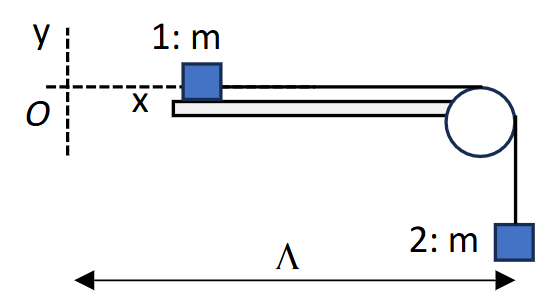
The x and y axes are represented as dotted lines. The origin of the coordinate system is O.
At time both masses have velocity 0. The rope is taut at all times.
(2 points) Draw a free body diagram of this system showing the forces acting on each of the masses.
(2 points) Give the definition of angular momentum and give for the angular momentum.
(2 points) Set up the total angular momentum of this system with respect to the given origin O.
(2 points) Set up N2 for the angular momentum of this system.
(2 points) Calculate the acceleration of both masses.
Question 4
Observer S’ moves relative to observer S with speed in the positive x-direction. The x and x’ axes are parallel. When the origins of S and S’ coincide, the clocks in S and S’ are set to .
At a photon with frequency is emitted from the origin of S that moves in the positive x-direction. This is event E1.
The photon is detected by S’ (at her origin) at some later time. This is event E2.
The photon reflects subsequently on a mirror that is at rest in S’. For S’ this means that the reflected photon has the same frequency as the photon before the reflection.
(1 points) Give the Lorentz Transformation and calculate the gamma factor for this problem.
(3 points) Determine the coordinates of E1 according to S’. Also determine the coordinates of E2 for both S and S’.
(2 points) Calculate the length of the interval E2-E1 and show that S and S’ find the same value. Classify the interval.
(1 point) Determine the frequency of the photon at E2 according to S’.
(1 point) Determine the frequency of the reflected photon according to S.
Question 5
Observer S’ moves relative to observer S with speed in the positive x-direction. The x and x’ axes are parallel. When the origins of S and S’ coincide, the clocks in S and S’ are set to .
In the frame of S’, a mass with speed collides (relativistically) with a stationary particle with mass . After the collision there is 1 particle.
(1 point) Give the definition of four-momentum for a particle with mass and speed .
(2 points) Determine the speed and mass of the particle after the collision according to S’.
(2 points) Determine the speed of the particles before the collision according to S.