Worked examples
Overtaking on the road
On the highway, an overtaking maneuver begins when two cars are about apart and ends when the faster car has passed the other car and is ahead of it. Car 1 is traveling at and car 2 at .
Calculate the distance traveled by car 2 for this move.
What happens when a ball is tossed out of the window when the cars are next to each other? Consider it from car 1 car 2 and the other way around.
How would the trajectory of the ball be described by the different drivers, and for a person next to the road?
The relative velocity is .
The total distance traveled by car is !
Although the cars are next to each other, they have a relative velocity to each other. The ball can therefore not be caught by the other. For the thrower the ball remains parallel to their own car. For the catcher the ball seems to travel backwards (other direction than the var is moving). A person next to the scene will always see the ball moving in the same direction of the cars.
Examples
Demo
A ball is bouncing at a wall. The mass of the wall is much greater than that of the ball. So, acceleration of the wall or changes in momentum of the wall can be ignored.
On the left side, we see this from the perspective of an observer, S, standing next to the wall. The right side shows what observer S’, who is traveling with the ball as it moves towards the wall, sees. Notice, that both S and S’ are inertial observers. That is, they keep their velocity and are no part of the collision.
What would Galilei say?
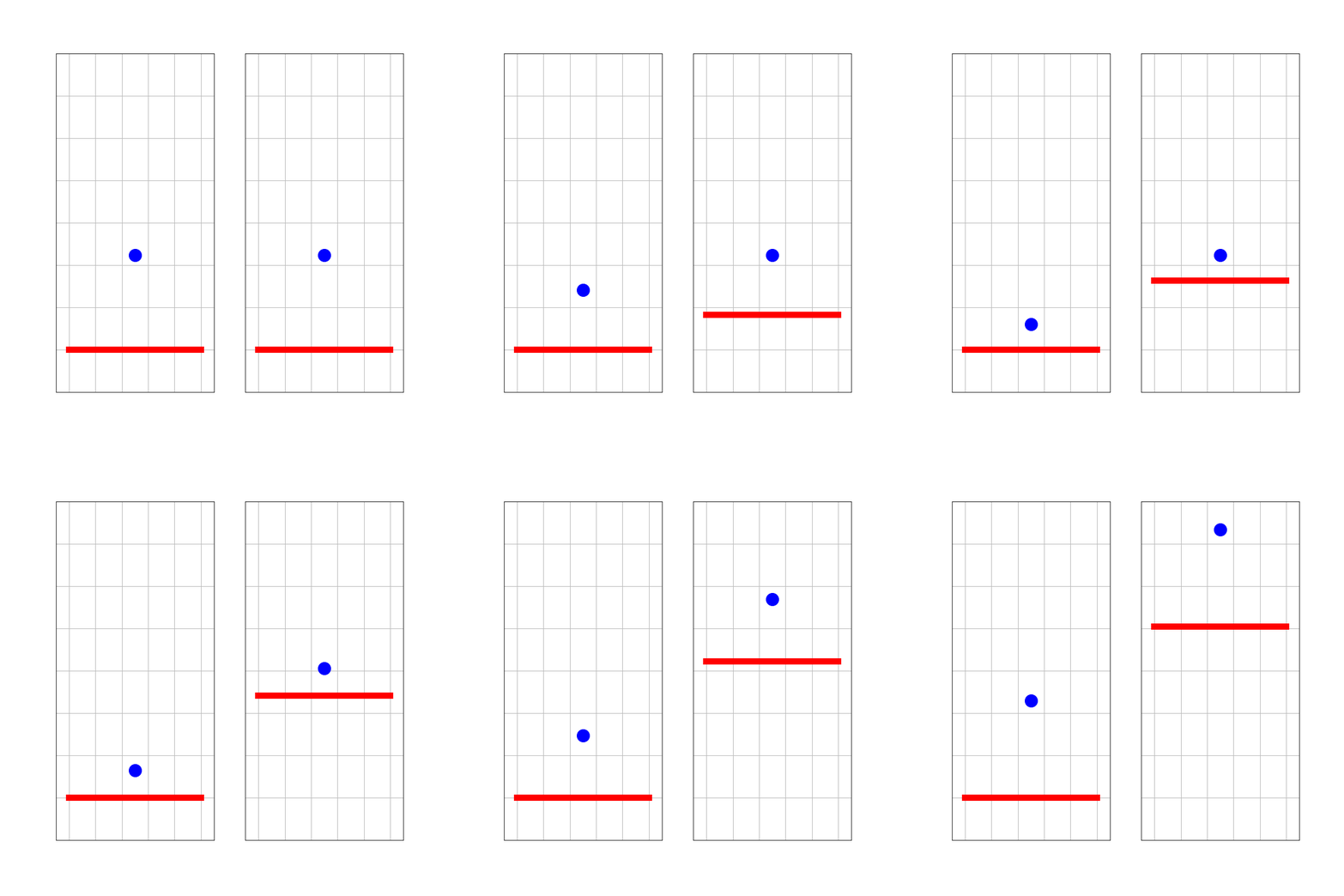
Figure 6:Ball bouncing at a wall.
Exercises
Answers
Solution to Exercise 1
First we make a new sketch, now showing the two observers and and their axis. We have made the velocity of the object red, the color of . And we have given the coordinates of the front and back of the train in grey as these are specified according to . We do this, as it is is crucial to realize that we have ‘mixed’ information.
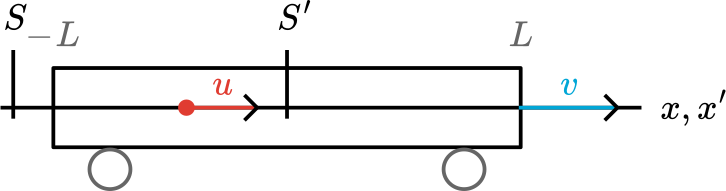
The velocity of the object is according to . The observer in the train, , sees a different velocity.
The observer in the train will denote the position of the front of the train by and of the back . Both are, according to , fixed values. But will see that differently.
According to , the object moves with velocity . Note that this is a negative value, otherwise the object will not hit the back of the train.
will describe the trajectory of the object by: with . Thus, the object will hit the back of the train at:
What does observe? It will write for the trajectory of the object (where we used that the object was released in the middle of the train at and both observers chose that as their origin).
According to also the back of the train is moving. It follows a trajectory , since at the back of the train was at position according to . The two will collide when
Hence we have and as times of collision. But we already found . If we substitute this in we get
Thus, indeed both observers see the collision at the same moment.
Sneak Preview: much to our surprise, when we enter the world of Special Relativity, this will no longer be the case!
Solution to Exercise 2
The particle will ‘collide’ with the bump. This might cause the particle to start moving to the left. How to analyse this situation?
Perhaps it is easier when we view this from the point of view of an observer moving with the table.

Now we have a situation of a particle moving over a friction less table with velocity . If we use conservation of energy, we can write down:
where we have taken as the height above the table and denote the velocity of at some point by . The initial height is zero and the initial velocity is .
So, if the initial velocity is such that , the particle will go over the bump and come back to height . It will thus pass the bump and then continue moving with velocity . For the original observer this means: the bump will pass the particle and after passing the particle is again laying still (but not at the same position!).
If, on the other hand is such that , the particle will not reach the top of the bump: it has insufficient kinetic energy. In stead it will stop at some height and then fall of the bump again. It will continue with velocity at the flat part of the table. To the original observer this means that first climbs the bump and returns to get a velocity on the flat part of the table.
The final possibility is . In that case the particle will exactly reach the top of the bump and stop there.
N.B. We have assumed that the bump is not too steep, because in such a case the particle will have a real collision with the bump. Think, for instance, of the bump as a sudden step. Then no matter how fast the particle is moving, it will not end up on the step, but bounce back.
Solution to Exercise 3
First, a sketch:
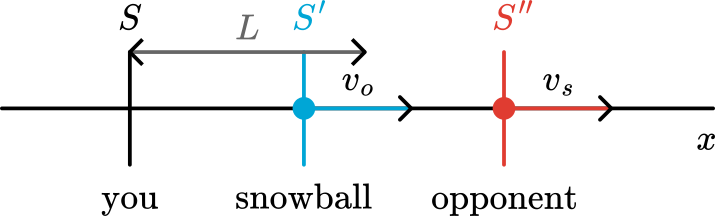
It is a 1-dimensional problem, so an -axis will do. We denote the velocity of your opponent (as seen by you) by and of the snowball . The inertial system of you is and you are sitting in the origin . Similarly, you opponents inertial system is with origin and finally the snowball has inertial system and the snowball sits in the origin .
Your perspective
require:
Your opponent’s perspective
require: since is in . Thus
Same time of course. Position: your opponent concludes she is not moving and this she is hit at .
The snowballs perspective.
According to the snowball . Thus,require:
And, again the snowball will conclude that it all happened in its origin.
Galilean Transformation
We now have three different time/place coordinates for the event ‘snowball hits opponent’.
We could have found this directly from a GT.
a. from to : we need to take into account that at the origins do not coincide. Instead is shifted over a distance L w.r.t.
Thus: and we get indeed
b. We do a similar exercise for to :
Thus: and we get